What is AGI? A plain breakdown of artificial general intelligence, how it differs from today’s AI, and when experts actually think it might arrive.
What Is AGI? A Plain-English Guide to Artificial General Intelligence
Artificial general intelligence, AGI, is a proposed type of AI that could learn, reason, and solve unfamiliar problems across virtually any domain at a human level, rather than being built for one narrow job the way today’s chatbots and image generators are. So what is AGI in practice, versus what gets marketed as AGI? No system has met that bar yet, at least not by the rigorous benchmarks researchers use to test it, despite plenty of headlines claiming otherwise. The gap between what AGI actually means and what companies say when they use the term is the real story here, and it’s worth understanding before the label gets attached to the next product launch.
Here’s what AGI actually requires, how it differs from the AI you already use, and what serious forecasters currently think about when it might show up.
AGI vs Narrow AI: What Actually Separates Them
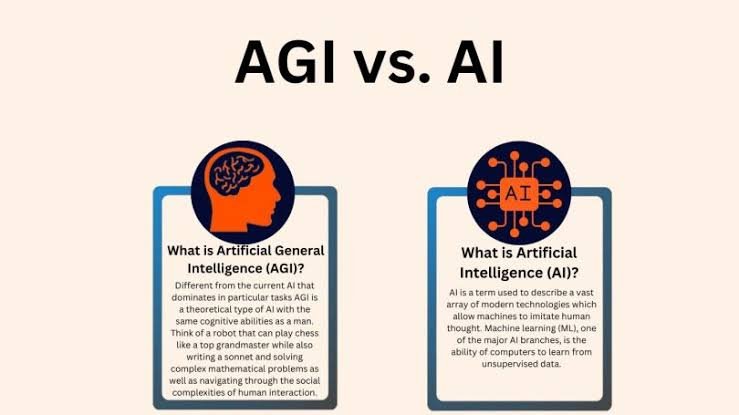
Every AI product you’ve used so far, ChatGPT, Claude, Gemini, image generators, voice assistants, is narrow AI, no matter how impressive it looks in a demo. Narrow AI, sometimes called weak AI, is built and trained to perform a specific task or cluster of related tasks. It can be extraordinarily capable within that lane, drafting an essay, writing working code, generating a photorealistic image, and still be unable to transfer that skill to a genuinely unfamiliar domain without retraining.
Answering what is AGI really means answering what none of those tools can do, since AGI would need to work in an entirely different way. Researchers generally describe it through a handful of traits: the ability to transfer knowledge learned in one domain to a completely different one, common-sense reasoning about the world, autonomous goal-setting without step-by-step instructions, and the flexibility to pick up a brand-new skill from just a few examples the way a person can. Put simply, AGI vs AI narrow systems comes down to breadth. One does a job well; the other would need to do essentially any cognitive job at all.
Has AGI Already Been Achieved? The Marketing vs the Benchmarks
Four percent. That’s roughly what today’s leading AI systems scored on ARC-AGI-2, a benchmark built specifically to test the kind of abstract, novel-problem reasoning AGI would require, while average humans scored close to 100%. A newer version, ARC-AGI-3, launched in March 2026 with an even harder problem set, and frontier models from OpenAI, Google, and Anthropic reportedly scored under 1% against a human baseline near perfect. Those numbers sit awkwardly next to public claims from industry figures, including one prominent hardware CEO who has said AGI already arrived, and Anthropic’s Dario Amodei, who told a Davos audience earlier this year that a “nation of geniuses in a data center” was plausible within a year or two.
It’s a strange moment to watch, definitions bending depending on which announcement a company wants to make that week. Part of the confusion is contractual as much as technical: OpenAI’s original 2019 partnership agreement with Microsoft included a clause voiding Microsoft’s exclusive rights the moment OpenAI’s board formally declared AGI achieved, and because the contract never nailed down a measurable definition, the clause became a genuine point of negotiation before both companies removed it in April 2026. When a hundred-billion-dollar contract can’t agree on what AGI means, a marketing tagline probably shouldn’t be trusted to settle it either.
AGI vs Superintelligence (ASI): Where’s the Line?
Where does AGI stop and superintelligence begin? AGI, as most researchers define it, would match top human experts across the board, doing the intellectual work of a skilled person, or a large team of them, without needing task-specific retraining. Artificial superintelligence, or ASI, describes something further out: a system that doesn’t just match human experts but exceeds the best of them, in every domain, by a wide and possibly unbounded margin.
Philosopher Nick Bostrom’s writing on the subject frames the jump from AGI to ASI as potentially fast rather than gradual, since a sufficiently capable system could improve its own architecture faster than humans could follow or intervene. That scenario, often called an intelligence explosion, is why ASI gets treated as a separate and more severe risk category rather than just a more powerful version of AGI. Both remain theoretical as of 2026. Neither has a settled technical definition, though ASI sits meaningfully further from anything currently built.
When Will AGI Arrive? What the Forecasters Say
Forecasters have gotten a lot more aggressive lately, though they still disagree by decades. The table below pulls together some of the more closely watched estimates from 2026.
| Source | Estimate |
|---|---|
| Metaculus forecaster aggregate (Feb 2026) | 25% chance by 2029, 50% chance by 2033 |
| Forecasting Research Institute’s LEAP expert panel | 50% chance by 2030, on an 8-hour expert-task benchmark |
| LEAP superforecasters | 2028 median, on the same benchmark |
| LEAP general public respondents | 2037 median |
| Sam Altman (OpenAI) | Has publicly pointed to around 2035 |
| Dario Amodei (Anthropic) | Has pointed to timelines as near as 2026–2027 |
Ask five researchers when AGI will arrive, you’ll get five different years, and the spread between the earliest and latest guesses in that table alone spans roughly a decade. Even the definition each forecaster uses varies enough that direct comparisons are shaky. Older long-run surveys of AI researchers, for context, put a 50% chance of human-level machine intelligence around 2047, a full 13 years later than a similar survey from just a year earlier, which gives some sense of how fast these numbers have been moving.
Why the AGI Race Is Making Its Own Builders Nervous
OpenAI and Anthropic don’t agree on much publicly, but this August they agreed on something big. On August 1, 2026, more than a thousand employees across OpenAI, Anthropic, Google DeepMind, Meta, and Mistral signed a joint statement called “Pacing the Frontier,” asking governments to help build international tools capable of deliberately slowing automated AI development. Both companies’ official accounts endorsed it within days, and Anthropic’s own leadership pointed to its internal research on recursive self-improvement, AI systems that help build the next version of themselves, as part of the reasoning.
The concern isn’t science fiction dressed up as policy. It’s that automating AI research itself could create a feedback loop that outpaces the humans meant to be overseeing it, long before anyone agrees a system has crossed into AGI territory in the first place. Google DeepMind CEO Demis Hassabis has separately pushed back on some of the more bullish AGI claims, pointing out that current models still get basic questions wrong often enough to undercut confidence in near-term timelines.
What AGI Would Actually Change
Trillions of dollars are already riding on a term nobody can precisely define. OpenAI’s own working definition, highly autonomous systems that outperform humans at most economically valuable work, ties AGI directly to labor and economic disruption rather than a specific cognitive test, which is part of why the debate spills so quickly into questions about jobs, regulation, and who controls the systems involved. Google DeepMind has proposed its own tiered framework instead, ranking capability across narrow and general domains separately rather than treating AGI as a single on-off switch.
Nobody actually knows where that threshold sits, least of all the people racing toward it. What’s clearer is the direction: benchmark scores keep climbing even as new, harder tests get built specifically to stay out of reach, and the gap between “impressive demo” and “AGI achieved” keeps generating exactly the kind of definitional arguments covered above. For a look at how that capability gap shows up in the AI tools available right now, Alice Tech’s ChatGPT vs Gemini vs Claude comparison breaks down where each mainstream assistant currently stands.
FAQs
What does AGI stand for?
AGI stands for artificial general intelligence, a proposed AI system capable of human-level performance across a broad range of cognitive tasks rather than one specialized function.
Is ChatGPT, Claude, or Gemini AGI?
No. All three are narrow AI, extremely capable at language and reasoning tasks, but none has met the transfer-learning and generalization bar that researchers use to define AGI, and none scores well on benchmarks like ARC-AGI-2 or ARC-AGI-3 built specifically to test it.
What’s the AGI vs AI difference in one sentence?
AI is the broad category covering any system that performs tasks normally requiring human intelligence, while AGI refers specifically to a system general enough to do essentially any of those tasks at a human level.
What’s the difference between AGI and superintelligence?
AGI would match top human experts across domains, while superintelligence, or ASI, would exceed the best human experts in every domain by a wide margin; ASI is considered further out and a distinct risk category.
When will AGI actually be achieved?
Nobody agrees. Public forecaster surveys put the median estimate somewhere between 2029 and 2033, industry leaders’ personal guesses range from 2026 to 2035, and long-run academic surveys have historically landed even later.
Who is building AGI?
OpenAI, Anthropic, Google DeepMind, and Meta are the most frequently cited labs pursuing AGI directly, each with a different technical approach and a different public definition of what counts as reaching it.
Is AGI dangerous?
Researchers and lab leaders disagree on timing but increasingly agree the risks deserve serious attention; over a thousand employees across major AI labs publicly asked governments in August 2026 to help slow down automated AI research specifically because of these concerns.